





A tour of the Lib Dems chances in both Scotland & Wales. We’ve also discussed Reform’s chances in Scotland and the Scottish Greens.
Local Dominance
In Scotland the Lib Dems are a huge player in the Highlands and Islands. I pressed our 1000 simulations a bunch of times and the only seat in all of Scotland that never, ever, went to the SNP was Orkney, that was probably 10k simulations with some wild swings and it always stayed Lib Dem. The Lib Dems have made this corner of the world their own for over a century and should pick up three constituency seats in the region, Orkney, Shetland, and Caithness, Sutherland and Ross are all relatively safe.
They have a pretty good chance in Argyll & Bute, plus they could take Skye, Lochaber and Badenoch if everything fell their way. They took the Westminster seat which largely overlaps with it in 2024 so it is possible. That would make them so dominant that they’d get 0 list seats in the Highland & Islands region and the SNP would get at least one instead, possibly even 2.
The Lib Dems are up slightly in the polls from 2021 and are hugely favoured in some constituencies outside of the Highlands. We expect them to take both North East Fife and Edinburgh North Western and they have a decent chance in Edinburgh Northern where the party clearly sees an opportunity. All in all, it would be very surprising if the Lib Dems don’t come out of the election with the second most constituency seats. They might even win more outright majorities than the SNP.
However, they’re going to struggle on the list so are going to be 6th overall unless the Tories fall apart. This is because outside of their core seats the Lib Dems are very weak, they’re very unlikely to get a list seat in Glasgow or Southern Scotland because they just don’t have any support there. They just barely beat Alba in Glasgow last time.
We think they’ll get about 6 seats, plus or minus a couple.
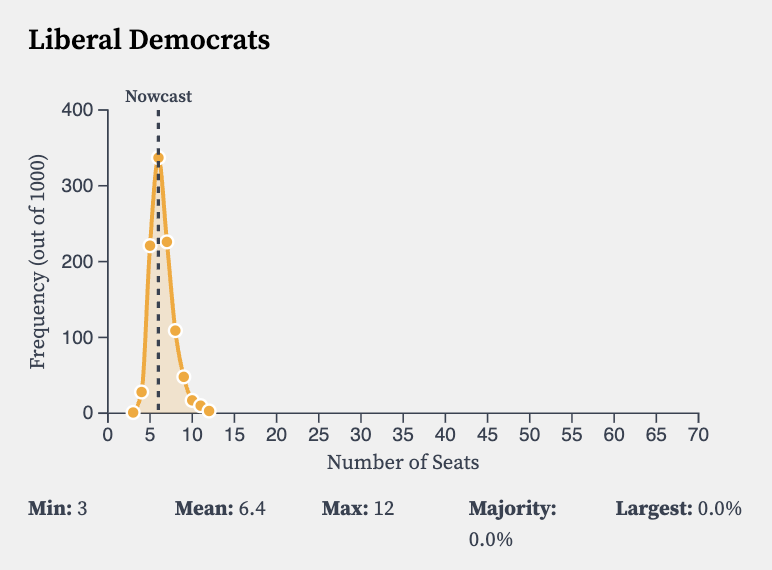
The Lib Dems demonstrate the benefits of smaller parties having concentrated areas of support under First Past the Post because it almost guarantees a few constituency wins. It does come at the cost of regional seats but that’s fine since their are more constituency seats than regional seats. Labour, the Tories and Reform may need to start learning from the Lib Dem approach if they don’t improve their overall vote shares.
The End of Liberal Wales?
The Lib Dems have always held a decent amount of support in parts of Wales, but haven’t maintained the strongholds that they have in Scotland. They’re not completely out of it but they’re polling at just 6%, this is better than the 3% they got last time but that’s a very low bar.
In Wales their best Westminster seat is Brecon, Radnor and Cwm Tawe which they won with 29.5% of the vote (which is absurd), this seat is combined with Neath and Swansea East at the Senedd to form Brycheiniog Tawe Nedd. It’s an odd seat, it cuts Wales in half diagonally and includes a huge rural area as far from the sea as you can get with most of the Swansea port.
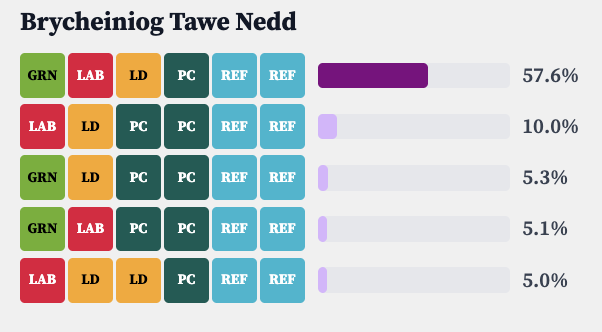
We’d be surprised if they didn’t get at least one seat here. Our model thinks their other hopes are Caerdydd Ffynnon Taf and Ceredigion Penfro, after that there’s a steep drop off. Our model thinks there are 8 theoretical seats that they could win if everything went their way.
One in Brycheiniog Tawe Nedd, Caerdydd Ffynnon Taf and Ceredigion Penfro, second seats in each of those and 1 in Casnewydd Islwynn and Fflint Wrecsam.
An absolute peak of 8 is not great, especially since their absolute low is 0 which happens more often. Their average is 3.
What are the Lib Dems for?
In 2010 the Lib Dems briefly polled in second place, their promises of free tuition fees and electoral reform resonated with a group of young, well educated urban dwellers who wanted an alternative to a tired Labour government who were not the Tories. For a long time the Lib Dems took up the mantel of being the most consistently pro-environment party which effectively kept a lid on the Greens.
Nick Clegg’s decision to join forces with the Tories, hiked tuition fees and agreed to a ridiculous referendum between no electoral reform and barely any reform. It rightly cost them almost all of their core support groups and left them with just a few dots of orange in South London and Orkney & Shetland. 10 years on and they’ve recovered from their absolute worst point but they still aren’t polling well. What’s odd is that by some metrics they’re doing really well, they won loads of seats in 2024 but much of this was driven by tactical voting and they have failed to build on it, when Labour voters are given the choice between a lacklustre Lib Dem and a Tory its an easy choice.
But, being less objectionable than the Tories isn’t an identity so they need something deeper than looking silly at waterparks.
I have a theory that they’ll do very well at the upcoming local elections in London but not because they’re winning many votes, they’re just standing still while everyone else collapses around them. The insult to democracy that is three-person-FPTP will massively reward them for it.