





The third in our party by party analysis. Last time I discussed Reform in Scotland, and I’ve talked about the Scottish Greens here.
An East West Split
Projecting Reform in Wales it’s a little easier than in Scotland in some ways, but more difficult in others. Again we have no proper Reform baseline but there was ‘Abolish the Welsh Assembly’. This party was led by Mark Reckless, a former UKIP MP who has followed Nigel Farage to both the Brexit Party and is now standing for Reform. It attracted a lot of the same kind of people as Reform. Our baseline, based on those built by Dr Jac Larner at Cardiff University, uses Abolish as a proxy for Reform which gives us a starting point.
It is a little simplistic to say Reform = Abolish, but it does track. Abolish were bigger in the Eastern half of the country, they struggled amongst Welsh speakers, were especially strong amongst people who identified as English, voted Leave, were male, and who used to vote Conservative. If you draw up an example Reform voter they tick all those boxes, it’s more or less the same list for the average Reform voter in England.
We have edited Jac’s numbers a fair bit but this core decision remains intact because the polling and 2024 UK general election results back it up. It puts Reform in a very strong position everywhere in the east and the post-industrial valleys, their vote share increases dramatically as you get closer to England and is particularly strong in the North East.
It fits quite neatly with identity, if you see yourself as Welsh only then Reform are probably not the party for you, if you are English or British then they could well be. If you speak Welsh regularly then you probably don’t like Reform, if you don’t speak any Welsh then you might.
Senedd Map
Loading map…
Reform are also likely to be strong beyond the Landsker line in Pembrokeshire and Carmarthenshire, but that’s only about a quarter of the Ceredigion Penfro constituency. All in all, the geography element isn’t as complicated as in Scotland.
Marginal Seats
Reform should win at least 1 seat in every constituency but could get as many as 3 in places like Clwyd, Pen-y-Bont Bro Morgannwg, Afan Ogwr Rhondda
The final two seats in every constituency are really, really marginal. This means that we’re pretty content with the first 4 seats in each seat are relatively safe but the last two are tricky. Lets take our Nowcast in Brycheiniog Tawe Nedd, we think Reform are going to take the first and fourth seats. If we’re over-estimating them by a little bit then they’ll take the first and fifth, if we’re underestimating them they’ll take the first and third. Either way, all fine.
In Caerdydd Penarth if we are overestimating Reform by 0.5% they’d lose a seat to the Greens. This isn’t unique to Reform, it’s an issue all across Wales because this is an awkward sweet spot. One one hand it’s pretty proportional but the line for getting the final seat is still quite high. If it was a lower threshold, by adding more seats, there’d be a lot more riggle room. If it was higher, with fewer seats, there’s be a higher barrier so fewer parties would be in the running.
Polling Chaos
Reform in Wales are also caught up in one of the most bizarre polling discrepancies of recent times. YouGov and More in Common have repeatedly found wildly different numbers for most of the major parties which makes everything even more confusing.
YouGov
More in Common
YouGov think Plaid are running away with it and also have excellent results for the Greens. They have Reform a safe second place on about and think Labour are way behind, with the Tories and Lib Dems even further back.
More in Common more or less agree on Reform’s vote share, 26-28%, but that’s it. They have Plaid behind Reform, Labour solidly in third place, with the Tories ticking over in 4th with the Greens and Lib Dems well behind.
YouGov and More in Common are both very well respected pollsters with excellent track records, YouGov were a bit better in Wales in the 2024 general election but they’ve entirely changed their methodology which which wipes the slate clean. Their new method is an MRP poll, at their best MRPs are excellent because they add nuance and subtelty to a bigger sample to improve local accuracy. At their worst they add extra layers of complicated maths which multiplies errors and makes results much, much worse. Two of the first three MRPs in Scotland (at of the time of writing) were firmly in the latter category, but the better one was by YouGov.
The only other regular pollster in Wales is Beaufort Research. As a general rule, a good poll should be conducted over a few days and collect 1,000ish people. This group spends about 3 weeks getting about 500 so we aren’t fans. For what it’s worth, their polls are closer to those of More in Common.
I’ve no idea which one is going to be closer. We weight YouGov & More in Common equally but our Nowcast naturally leans towards the More in Common position beacuse they’ve released more and Beaufort are also being factored in. The difference is so big that we’ve added polling average presets for each pollster.
Reform’s Problems
Reform have had issues over the past few weeks, both in Wales and in a more global sense. The party was forced to pull some of its Senedd candidates withing days of announcing them after a series of scandals, including one candidate who performed an alleged Nazi salute and filmed himself drink driving. They lost a series of other candidates to internal fights after the party decided to ignore its local branches and parachute in outsiders.
All of this raised concerns about who Reform vets its candidates and also where power lies in a party which claims to the voice of the left behind. The party is essentially devoid of internal democracy and also lacks a solid understanding of Welsh politics like the party’s campaign focusing on immigration despite the Senedd having no power over this. Misspelling two of the three Welsh words on the cover of their manifesto was particularly bad.
Global issues are also an issue. Farage has spent the past few years trying to get close to Donald Trump and immediately decried Kier Starmer’s decision to stay out of the war on Iran. Farage has spent few weeks walking this back as the idiocy of the war has become abundantly clear but this doesn’t fix that his initial judgement was awful. Prime Ministers don’t get two weeks to realise that the war they’ve already started was a bad idea.
Reform’s polls have dipped slightly recently across the UK but the changes are within the margin of error. Whether they come first or second is up in the air, but they are set to be a major player in Welsh politics either way.
Destined for Opposition
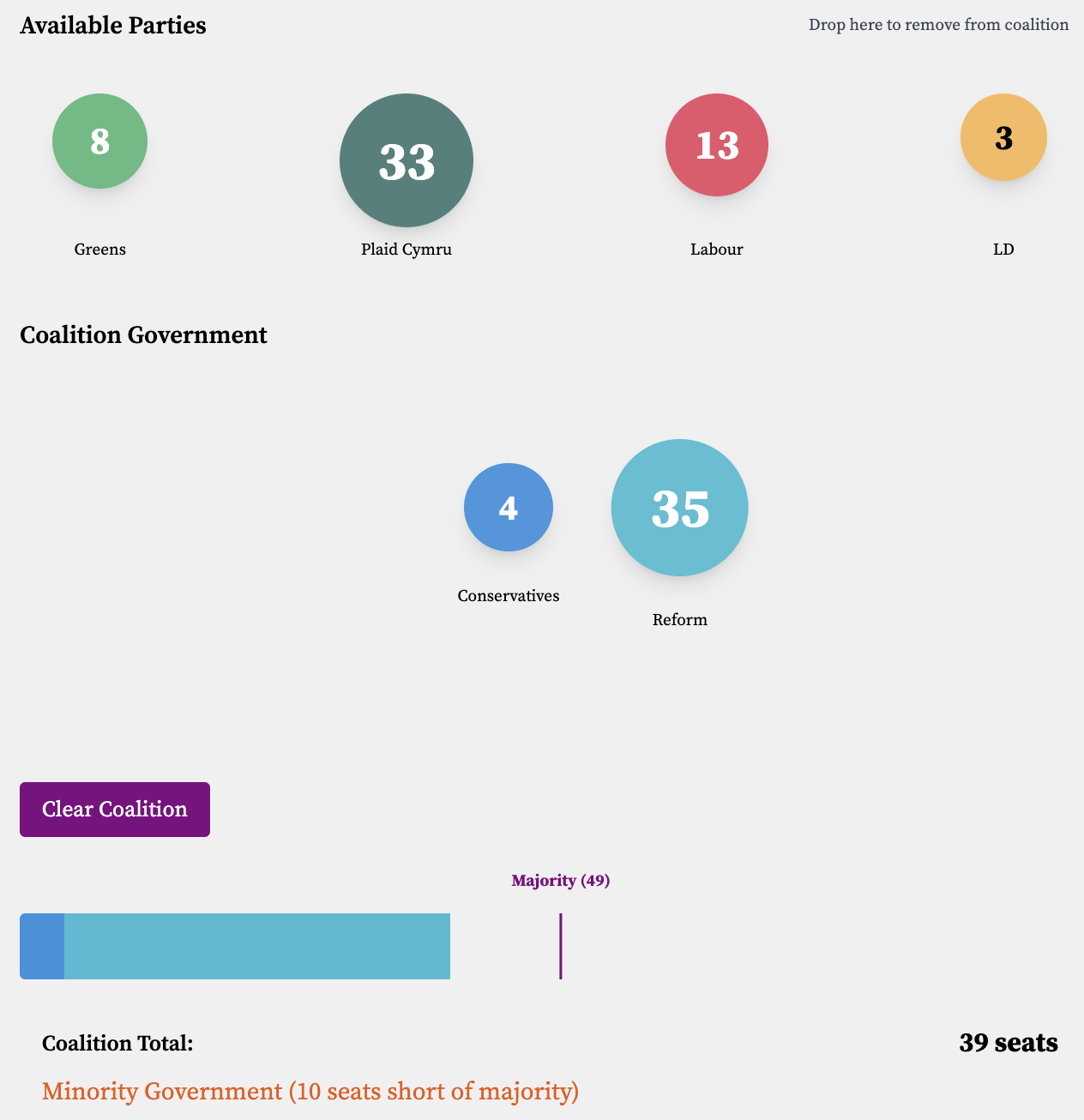
Even if they come first in seats Reform can’t govern Wales. To pass a budget you need the support of 49 Members of the Senedd, even with the backing of the Tories, Reform have no real chance on current numbers. Across 1000 simulations they peak at 41, but the Tories only win 4 in that scenario. In our Nowcast they’re even further away.
Reform have backed PR since their foundation, so did the Brexit Party and UKIP. Farage has always been in favour of systems exactly like this one and argued (correctly) that First Past the Post was freezing them out at Westminster by artificially giving more seats to bigger parties. Any Reform leaders complaining that PR is ‘undemocratic’ because they finally got as many seats as they deserved should be called out for being completely hypocrtical.
The best option for Reform is probably exactly this: largest party but not in government. They don’t need to make any difficult decisions and can pretend to wronged by basic maths that they were both well aware of and supported.