





Devolved Elections is delighted to announce a partnership with ElectHer to project the number of female candidates for the upcoming Scottish and Welsh elections.
Some of the numbers have been on our site for a few weeks now but as so many parties (Reform and the Greens) were slow to finalise their candidates we’ve had a lot of people listed as ‘Unknown’. Now almost everyone has been confirmed so we’re happy to start actually talking about the numbers.
There are a few ‘Unknown’ because some parties (mainly the Welsh Greens) are still not fully ready, but we will keep updating the numbers. We will finalise this at the close of nominations to account for any late additions and account for those who’ve withdrawn. 4 Reform and 1 Plaid candidate have already dropped out for one reason or another, so there could be more replaced in the next two weeks.
Wales
The new Senedd will be elected by a Closed List system so candidate names tend to be less important than party labels because voters cannot choose which Plaid/Reform/Lib Dem they want, they just pick 1 party. This gives parties full control over their candidate selections so, for any party looking at winning more than 5 or 6 seats, gender differentials are a choice. Parties can decide to take it into account and ensure some men and some women top winnable seats, or they can choose not to take it into account.
Following a by-election in 2003, the former National Assembly for Wales briefly had a female majority, this hasn’t happened before or since anywhere in Europe. However, Wales seems to be heading in the opposite direction since. Our Nowcast expects 38 women to be elected and 58 men, plus two as yet unnamed Green candidates.
Senedd Seat Distribution
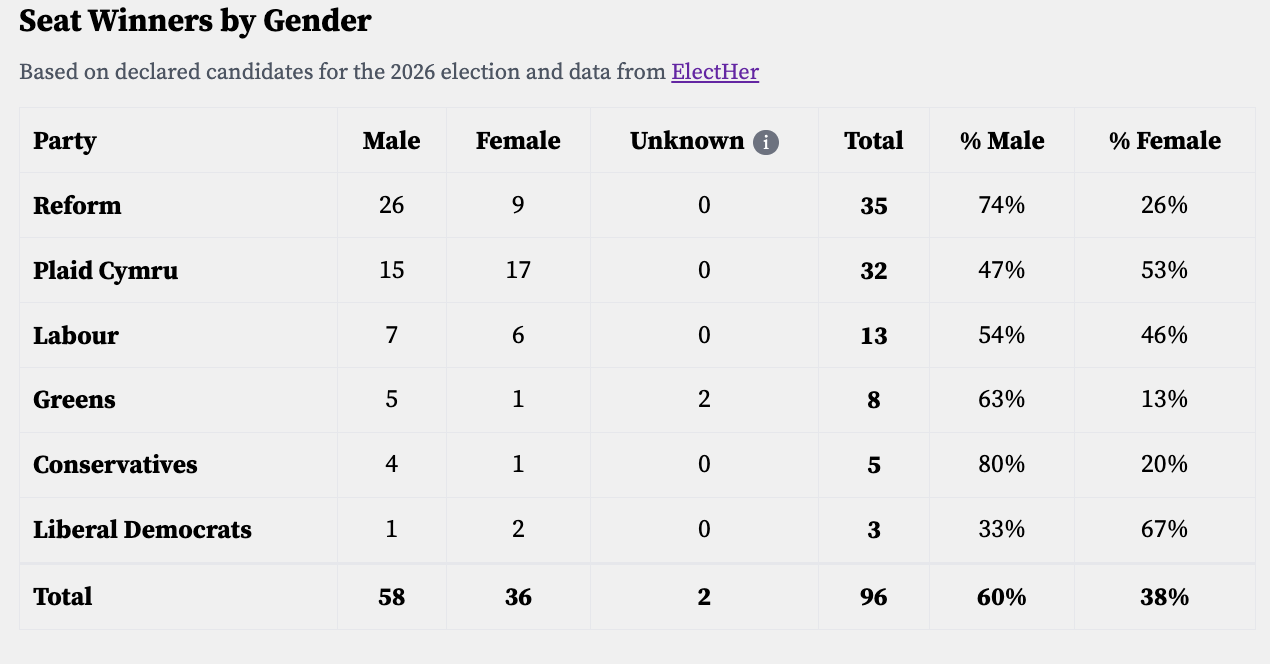
The biggest driver of this uneven gender split is Reform UK (although as we shall see, this is not the case in Scotland). They are expected to win 35 seats but only 24% have women in winning positions on the list, the Conservatives have an even more male-lean but we’re only expecting 5 Tory seats. The Greens are also male dominated, but that could change if women are selected to top their list in Brycheiniog Tawe Nedd and in second place in Caerdydd Ffynnon Taf.
Under current numbers we expect Plaid Cymru to finish in second place and to have more women than men elected (53%). Labour are also pretty close to 50-50 with 7 men and 6 women in list positions that should see them over the line.
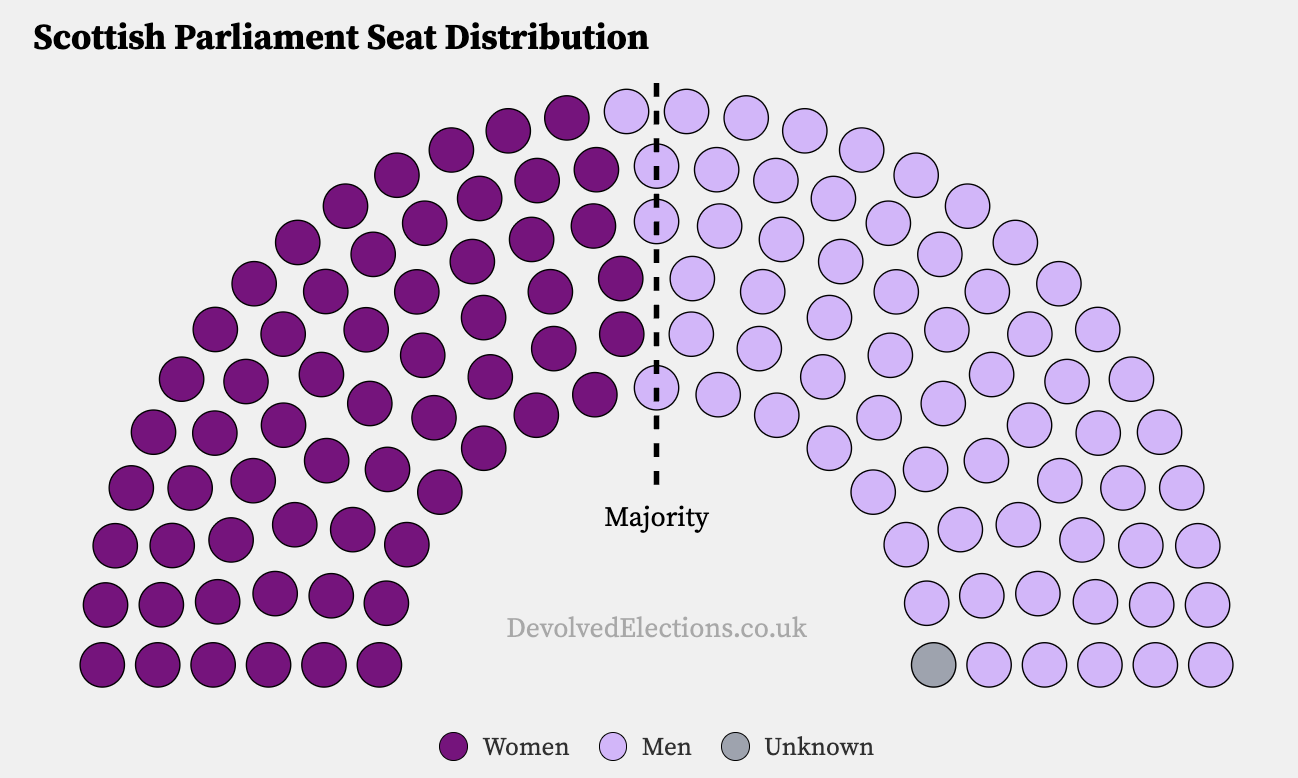
Scottish Parliament Seat Distribution
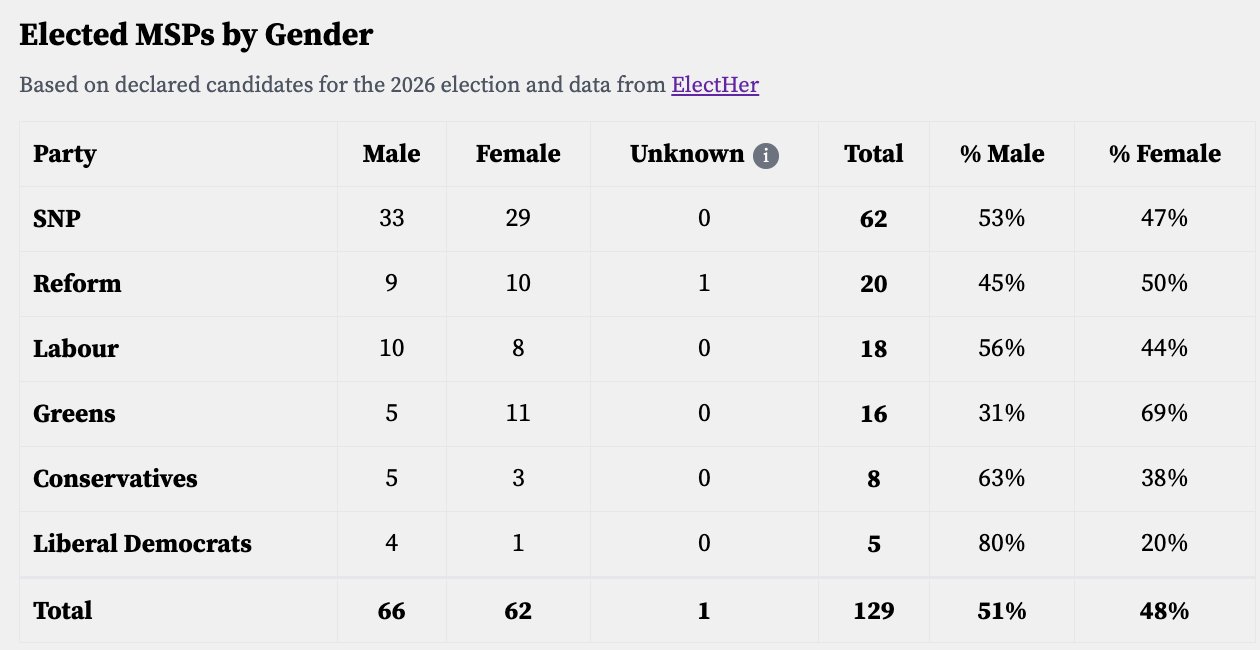
Scotland continues with AMS which means that parties can control the gender splits on the top-up regional list, but there’s a lot more candidate specific campaigning to do on the constituency seats which make up the majority of the parliament. Parties usually prioritise well known faces like sitting MSPs and councillors for these seats. When you combine a system which gives parties less control over which of their candidates can win with the fact that Scotland has, historically, had a worse gender split than Wales, we’d expect the number of successful women candidates to be lower. But it isn’t.
We expect 66 men and 61 women, plus 1 unknown from Reform* to be elected on our Scotland Nowcast, that’s 51% to 48%. This is driven by Reform with 45% men, 50% women in winnable seats and especially the Greens 31% men 59% women. Labour (56% men) and the SNP (53% men) are both reasonably well split, whilst the Lib Dems (80% men) and the Conservatives (63% men) have larger splits in favour of men.
Probabilities
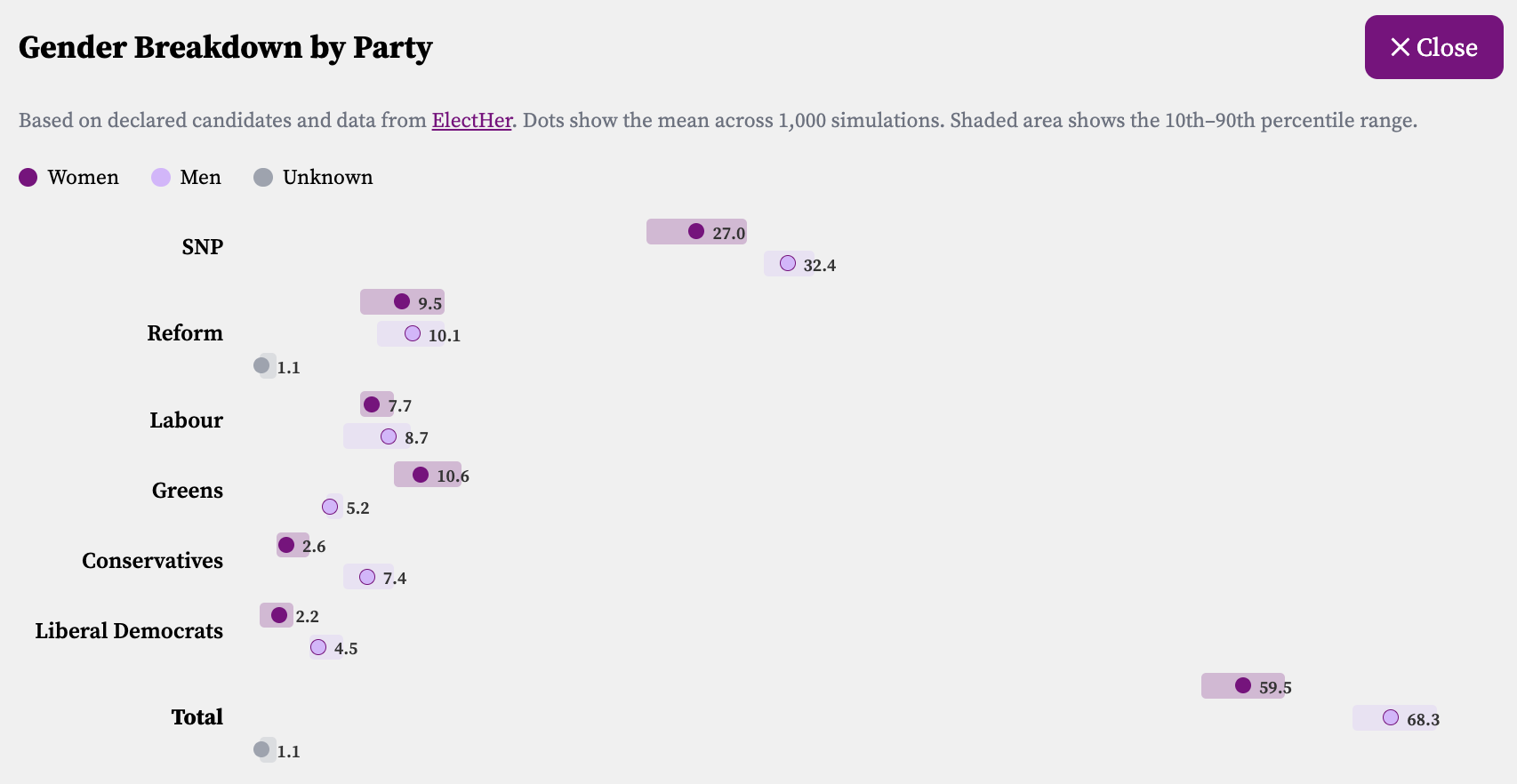
The numbers above come from today’s Nowcast and will change as new polls come in. So, to show the range of possibilities I turn to our 1000x election model. This shows the average gender split as well as the minimum and maximum number of women elected for each party across 1000 random variations of our projection.
You can run your own 1000x simulations anytime on Wales and Scotland, the numbers will adjust as polling trends change.
Welsh Probabilities
For most parties there are a range of outcomes on either side of the average, this shows the possibility of more or less people of that gender being elected. This shows the range of outcomes, if a party outperforms its polling average it will elect a few more people of each gender, that’s the whole point of this graph. Which is why I thought it was broken for Reform.
Reform in Wales have 9 women in incredibly safe list positions but no other female Reform candidates have any real chance. These 9 women win even if Reform underperform badly, they win if there’s a surprising geographic split in Reform vote, and they win if turnout goes against Reform because they are so well positioned on the list. But, after that it’s all men.
This is driven by places like Fflint Wrecsam. Reform’s list contains exactly 1 woman and she is first on the list. In every single scenario we throw at it, Reform wins at least 1 seat there, so she’s safe. Our system thinks Reform could end up with 2 or 3 in Fflint Wrecsam, so the only real uncertainty surrounds how many men will join Cristiana Emsley.
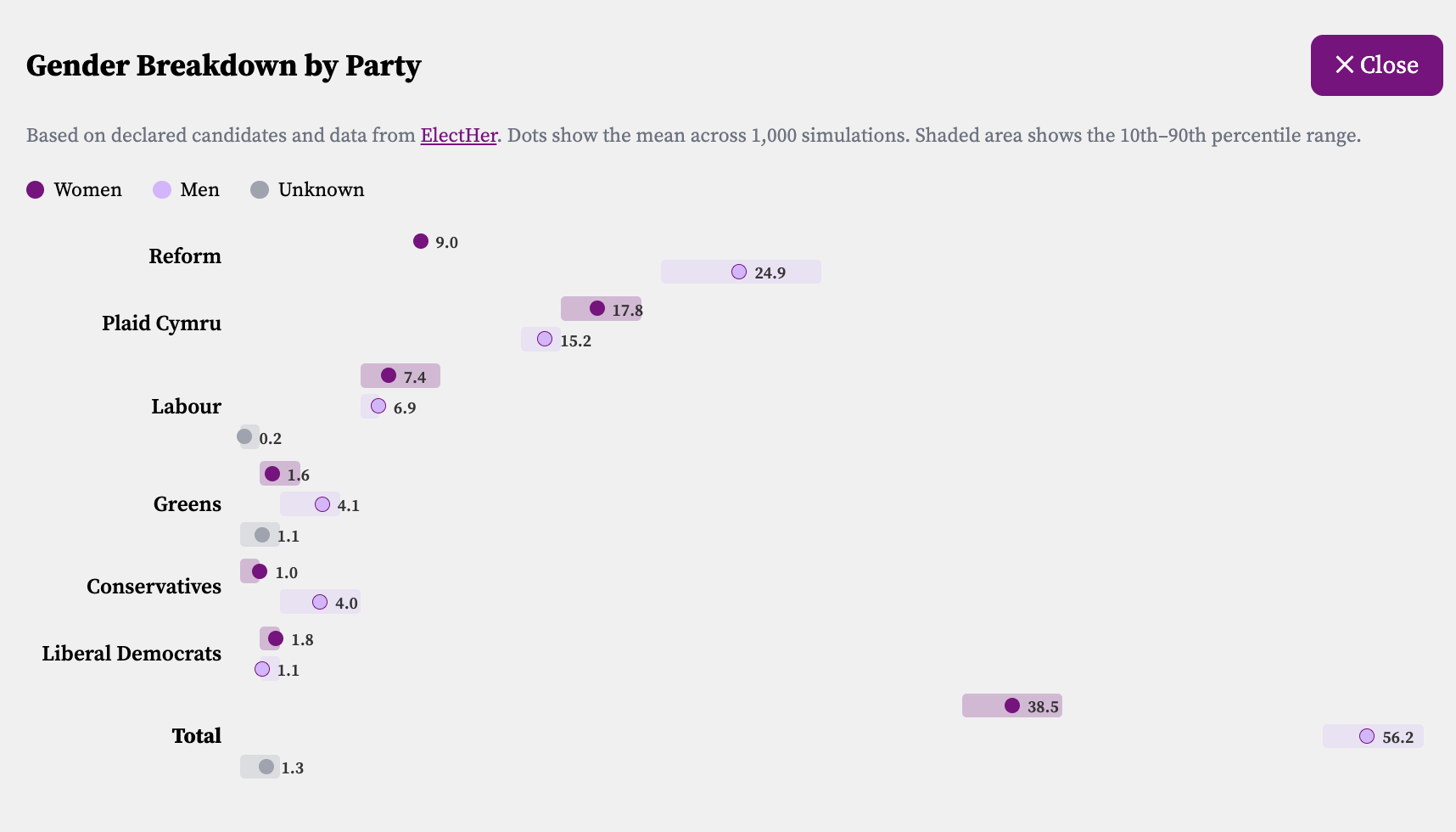
This exact scenario also happens in Gŵyr Abertawe and Sir Fynwy Torfaen. In other places, like Ceredigion Penfro, Reform have a woman in first place who always gets elected and there are more women on Reform’s 6 person list, but they’re so far down as to have no chance of getting elected.
That Reform has managed to almost entirely wipe out the uncertainty of how many women would get elected is genuinely difficult to do. It’s likely that some more uncertainty will seep in over the coming weeks, especially if there are any changes to the Reform candidate lists.
Scotland Probabilities
In Scotland the numbers are much more ‘normal’ for every party. The most uncertainty lies with the SNP. The party could potentially have quite a very wide gender split or a pretty narrow one. This is because they’re running women in 5 of the 7 most marginal constituencies: Argyll & Bute, Edinburgh Southern, Glasgow Southside, Dumbarton and Aberdeenshire West.
An older version of this blog did not include a Scottish probability graph.